Pentecost, Bulgakov, and the Spirit of Self-Surrender

The Holy Spirit is dwelling unseen in the world, as its quickening force and reality. But he is present there not only thus to establish the world in its distinct existence and life, but also to elevate humanity, once inspired by himself, all the way to the heights of divine inspiration: "Who spake by the prophets."
Sergei Bulgakov, Sophia, the Wisdom of God, 100.
One of the strengths of evangelicalism is its insistence on the cruciform nature of the Gospel. Without the "for us" death of Christ, there is no good news. Without the death of Christ, there would be no resurrection, and there is no Christian hope without the resurrection. However, as evangelicals, we need a fresh vision of the scope of the Gospel. We need to move the poles of the Gospel to include the full breadth of God's saving action in the world.
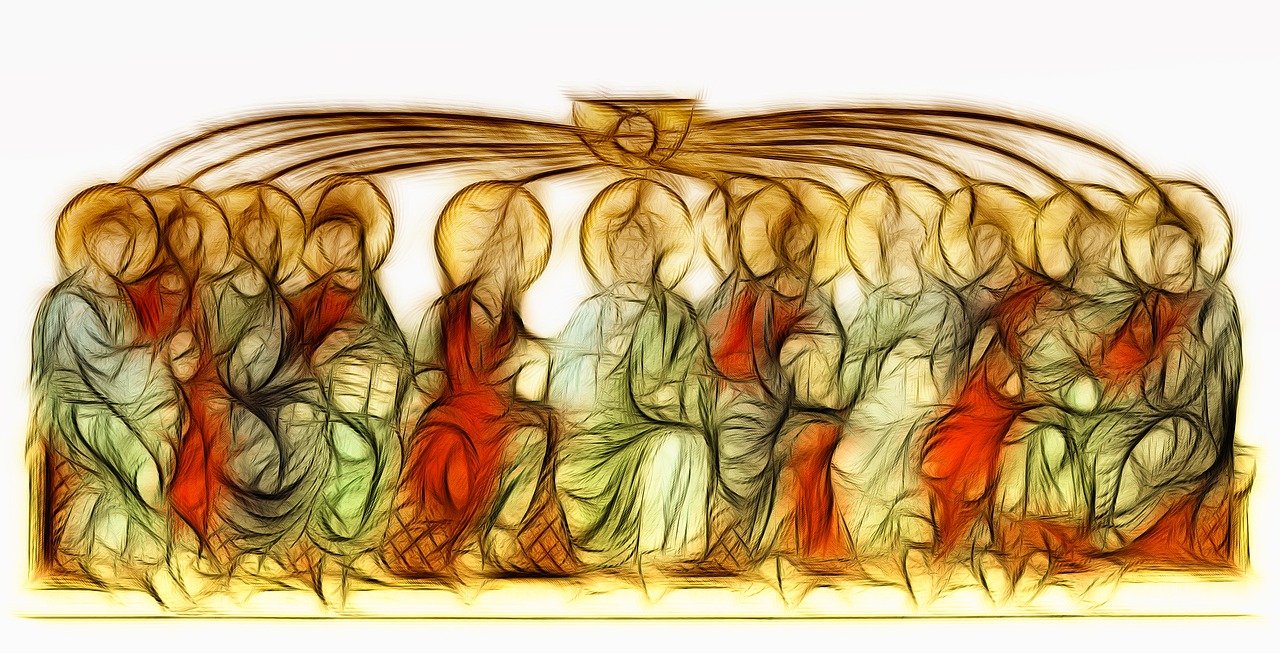
Yesterday the Church celebrated Pentecost. Pentecost, in many ways, is the telos or end of God's saving action. Pentecost represents the moment in which the shape of God's redemptive work is revealed. This shape is an ongoing, ever-expanding, multi-ethnic, participation in God's inner Trinitarian life. According to Bulgakov, the "ongoing Pentecost of the world is the mystery of the world's being, the ontology, history, and eschatology of the world" (Bulgakov, The Comforter, 341). The Incarnation of God becoming flesh, the Atonement of God dying to defeat Sin, and the Pentecost of God giving his very being to the Church, represent a staggering display of God's self-surrender in the fundamental "moments" of the Gospel. We cannot understand the power of Pentecost until we know this weakness (kenosis) of God.
The glorious descent of the Holy Spirit at Pentecost is consistent with the general character of God's manifesting power—a self-surrender "in virtue of which His action is revealed only in conformity with the preparedness of creation for this action, in conformity with creation's receptivity" (Ibid). The presence of the Holy Spirit was not a new phenomenon at Pentecost, but something at work since the beginning of creation. Throughout the Hebrew Scriptures, the Holy Spirit moves to convict, reveal, protect, restore, and lead his people. It was the voice of the Holy Spirit that opened the ears of the prophets. It was the Holy Spirit who bestowed the gift of faith to a person who called on the name of the Lord. However, according to Bulgakov, "the utterly new thing that occurred in the Pentecost was not the descent into the world of the 'spirit of God' in the capacity of His gifts, but the descent of the hypostatic Holy Spirit himself" (Ibid, 267). For Bulgakov, the descent of the Spirit at Pentecost is "completely analogous to the descent from heaven of the Logos for the purpose of His Incarnation" (Ibid). Although these vocations are unique, they are in effect 'one salvation' and 'one humanity of God' (Paul Valliere, Modern Russian Theology, Bukharev, Soloviev, Bulgakov: Orthodox Theology, 329.) The hypostatic descent of the Holy Spirit at Pentecost stands in continuity with creation, or as Bulgakov labels it, "the sanctification or spiritualization of the cosmic matter" (The Comforter, 343). Pentecost, then, is fundamental to our understanding of redemption.
The self-surrender of the Holy Spirit takes shape in transforming the world into the likeness of Christ. For it is for Christ and from Christ that the Holy Spirit finds his fulfillment (John 14:26, John 20:22). However, the eschatological reality of a now and not yet kingdom means the Holy Spirit defers the fulness of his transformative action until a future moment in time. The Spirit limits himself in creation by allowing humanity to grow and develop, a process that mirrors Christ's development. This does not suggest that Christ was a sinner in need of redemption by the Holy Spirit, but merely that Christ's life was a genuine human experience. For example, in the incarnational life, there was an "initial reposing of the Holy Spirit upon Jesus the Divine Infant and Divine Youth, a reposing which is proportional to the measure of human growth and limited by this measure, is already the kenosis of the Spirit" (The Comforter, 251).
A Spirit Shaped Church
What does this mean for the Church? To begin, the Holy Spirit is graciously transforming the Church into the likeness of Christ. However, this transformation is a process. Our work in the world must take the shape of the Spirit's work in the world. The Holy Spirit finds his fulfilment in his self-surrender, and the Church must do the same. Just as the shape of the Holy Spirit's activity takes from in being other-focused (on creation, on Christ, on the Church), the Church must do likewise.
If our aim is power, we have failed to grasp what it means to be a Church filled with the Spirit of self-surrender.
What better time to be reminded of Pentecost than in a world ravaged by racial tension and police brutality? The scope of Pentecost's invitation to experience the Triune life of God was not subject to national boundaries. Racism–that ugly wielding of power of one group over another–was utterly condemned by the Spirit's descent at Pentecost.
Finally, the story of Redemption needs both the beautiful messages of the cross and the mysterious outpouring of God’s kenotic transformation through Pentecost. The Holy Spirit’s self-surrender in Pentecost’s movement towards the new creation comforts us in our suffering. In the Holy Spirit’s descent at Pentecost, God further identifies himself as a God of surrender, a wonderful triune God of selfless giving. I can think of no more excellent gift for the Church to give than to reveal this God to the world.